
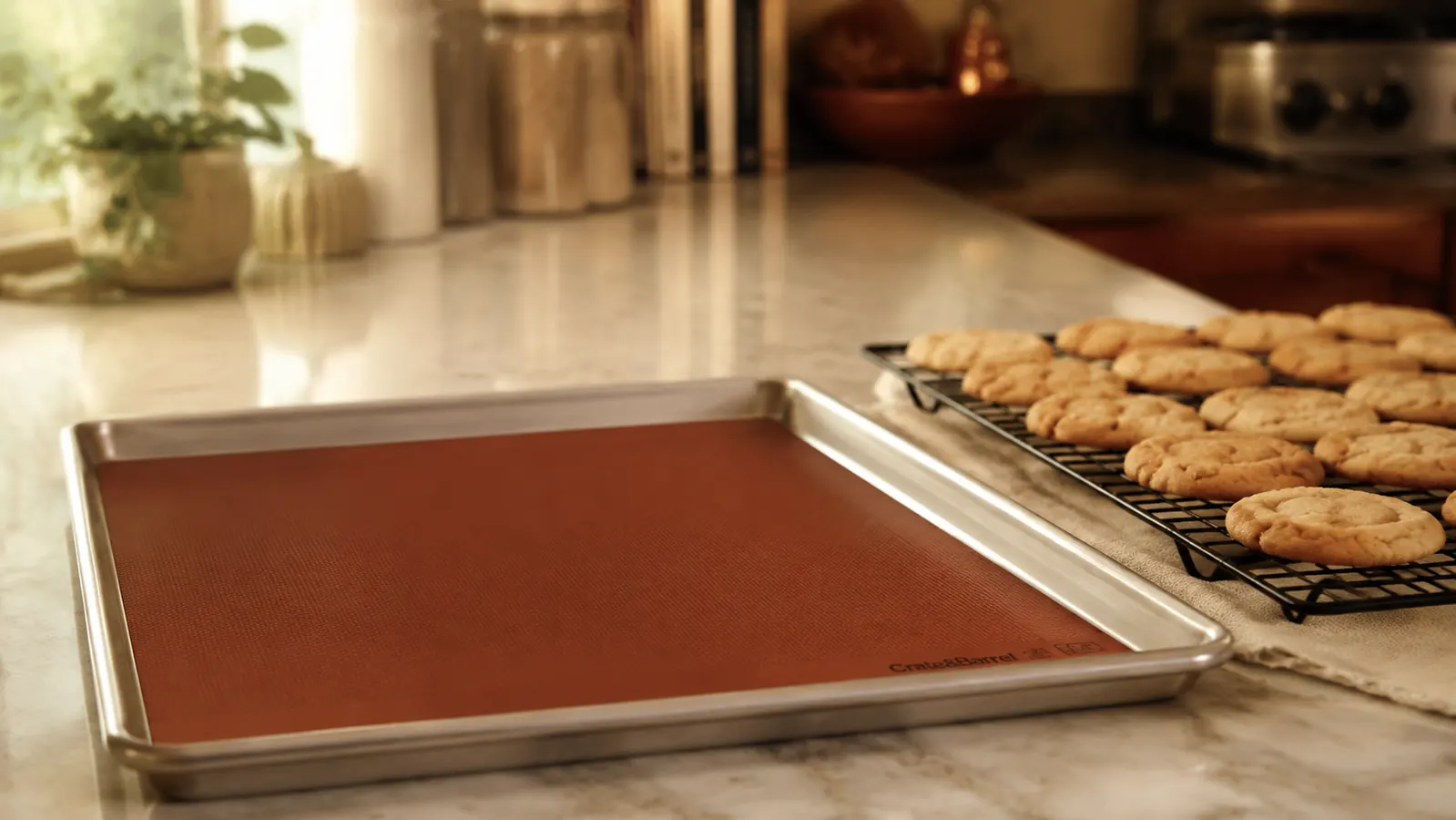
I am not precious about kitchen gear. If something earns its drawer space, it stays. If it clutters up the cabinet and rarely pulls its weight, it goes to the donate pile. The Amazon Basics silicone baking mat is still here, eight months in, and it has been on my sheet pan almost every single time I have turned on the oven. That pattern started in October when I picked up a two-pack on a whim, and it has not changed since. By now I have a pretty clear picture of what this mat does well, where it falls short, and whether the upgrade from parchment paper is actually worth making.
A little context about how heavily I tested it: I bake cookies three or four nights a week, roast vegetables on sheet pans for weeknight dinners, and occasionally do sticky things like candied nuts, glazed chicken pieces, and roasted garlic. My two kids eat a lot of frozen bites and pizza rolls that go on sheet pans too. Before this mat, I was burning through a roll of parchment paper every two to three weeks and still fighting uneven browning and the occasional stuck cookie. At the current price for a two-pack, I figured the worst case was I was out less than the price of two rolls of parchment. Turns out the best case was a lot better than that.
The Quick Verdict
A genuinely useful baking mat that delivers even heat, near-zero sticking, and remarkably easy cleanup at a price that makes the switch from parchment paper a no-brainer for anyone baking more than once a week.
Amazon Check Today's Price →Done buying parchment rolls every month? This mat pays for itself in a few baking sessions.
The Amazon Basics silicone baking mat has earned 4.7 stars from more than 25,000 buyers on Amazon. Check today's price and see if the two-pack is still in stock.
Amazon Check Today's Price on Amazon →How I've Used It: 8 Months of Real Baking
My household runs on sheet-pan cooking. I have two half-sheet pans that basically live in the oven rotation, and these mats have been on both of them since the fall. In a typical week I use each mat at least five or six times: chocolate chip cookies, snickerdoodles, roasted broccoli or sweet potato, frozen snacks for my kids, granola, and the occasional tray of roasted cherry tomatoes. That adds up to somewhere around 170 to 200 individual oven sessions across both mats over eight months. I feel good about that as a sample size.
Temperature range for my uses spans 325 F for delicate shortbread all the way up to 450 F for crisping vegetables fast. The mats are rated to 480 F, and I have not pushed that ceiling, but 450 F is serious heat and neither mat has shown any warping, discoloration, or off smell beyond the first two or three uses. That initial faint rubbery scent is normal for new silicone products and it faded completely by the fourth session. Since then, nothing.
One practical note on technique: I never preheat the pan with the mat on it. I load the mat cold with whatever I am baking, slide the cold pan and mat into the preheated oven together, and bake normally. Some silicone mat guides suggest preheating the pan separately first, but I have not found that necessary, and I prefer not to handle a hot bare sheet pan unnecessarily. My results have been consistent either way.
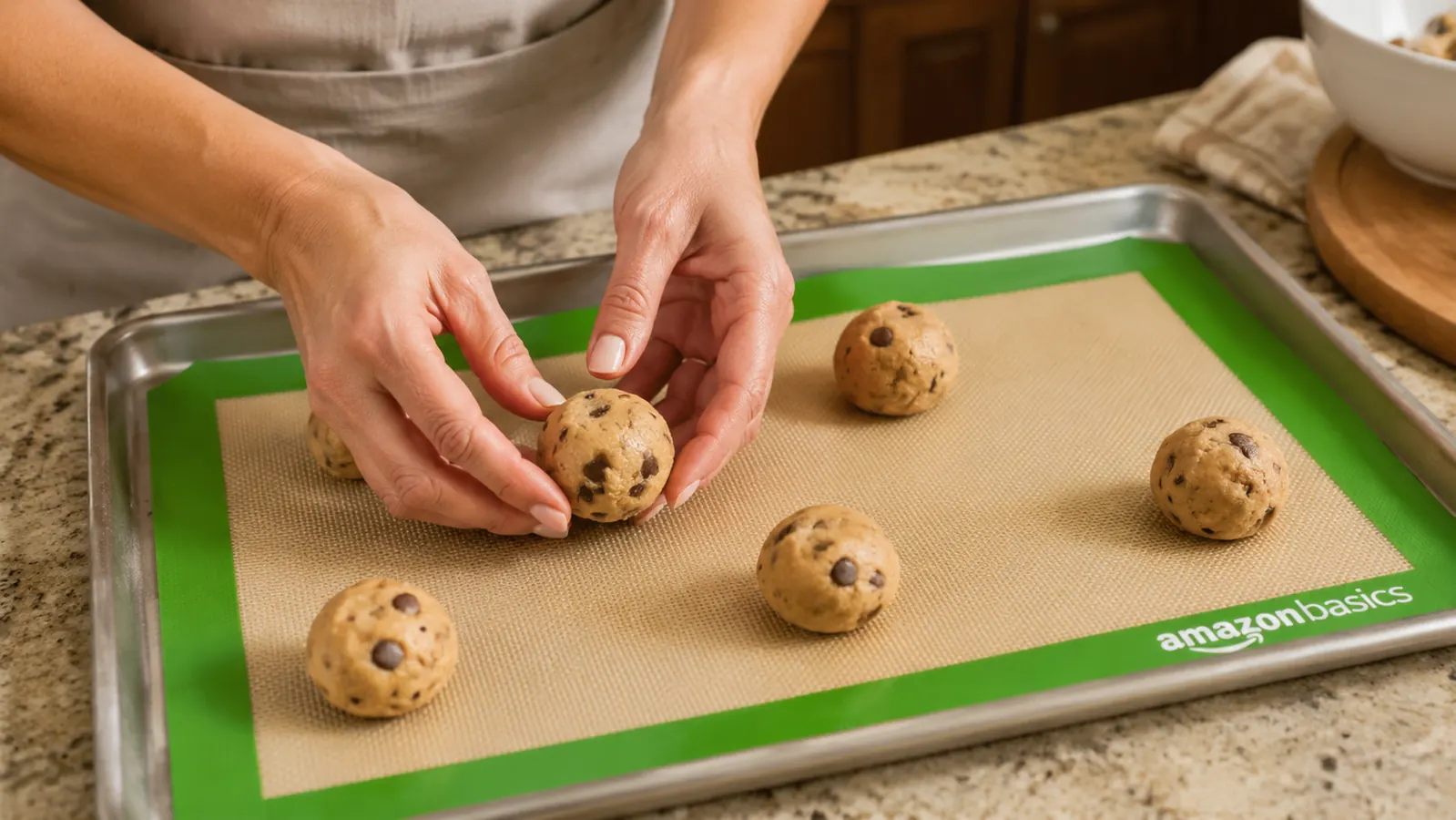
Heat Distribution and Baking Results
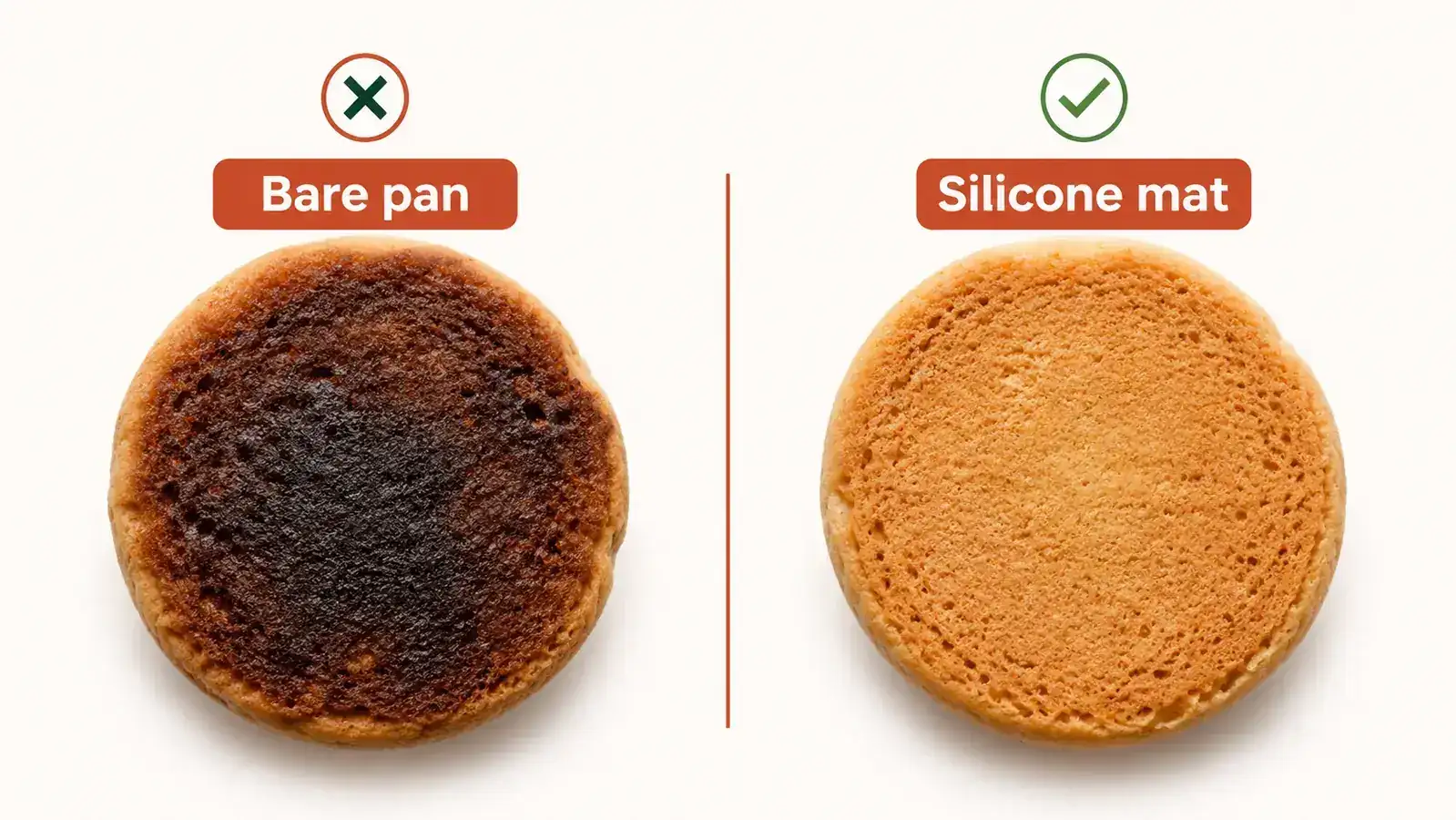
The most immediate improvement I noticed was how much more even the browning became on cookies. My oven has a warm spot toward the back right corner, which means without intervention I always pull batches where the back cookies are darker than the front ones. I compensate by rotating the pan halfway through baking, and I still do that, but the difference between the front and back cookies shrank from obviously noticeable to barely worth worrying about. The silicone mat, with its fiberglass mesh core, spreads heat more uniformly across the pan surface than a bare metal sheet does.
For roasted vegetables, the mat acts as a gentle buffer between the metal pan and the food. Broccoli florets come out with caramelized edges and slightly softened undersides rather than scorched flat sides touching the pan directly. Brussels sprouts brown nicely on top without burning on the cut side. Sweet potato rounds caramelize evenly. These are real improvements for anyone who has dealt with one burned side and one pale side on roasted vegetables. The mat does not prevent browning, it just makes it more controlled.
The place the mat underperformed my expectations was with extra-thick, very cakey drop cookies. Those need direct bottom heat to set a firm base. The silicone insulates just enough that cakey cookies sometimes stay soft on the bottom longer than I prefer, which can make them feel underbaked even when the top is set. For thin crispy cookies, classic chocolate chip drop cookies, shortbread, and anything where you want golden rather than firm-bottom results, the mat is terrific. For cakey cookies I keep a sheet of parchment or just bake directly on a lightly greased pan.
Eight months and roughly 180 oven sessions later, not one cookie has stuck. That alone made the price back in the first two weeks.
Cleanup: The Part That Actually Changed My Routine
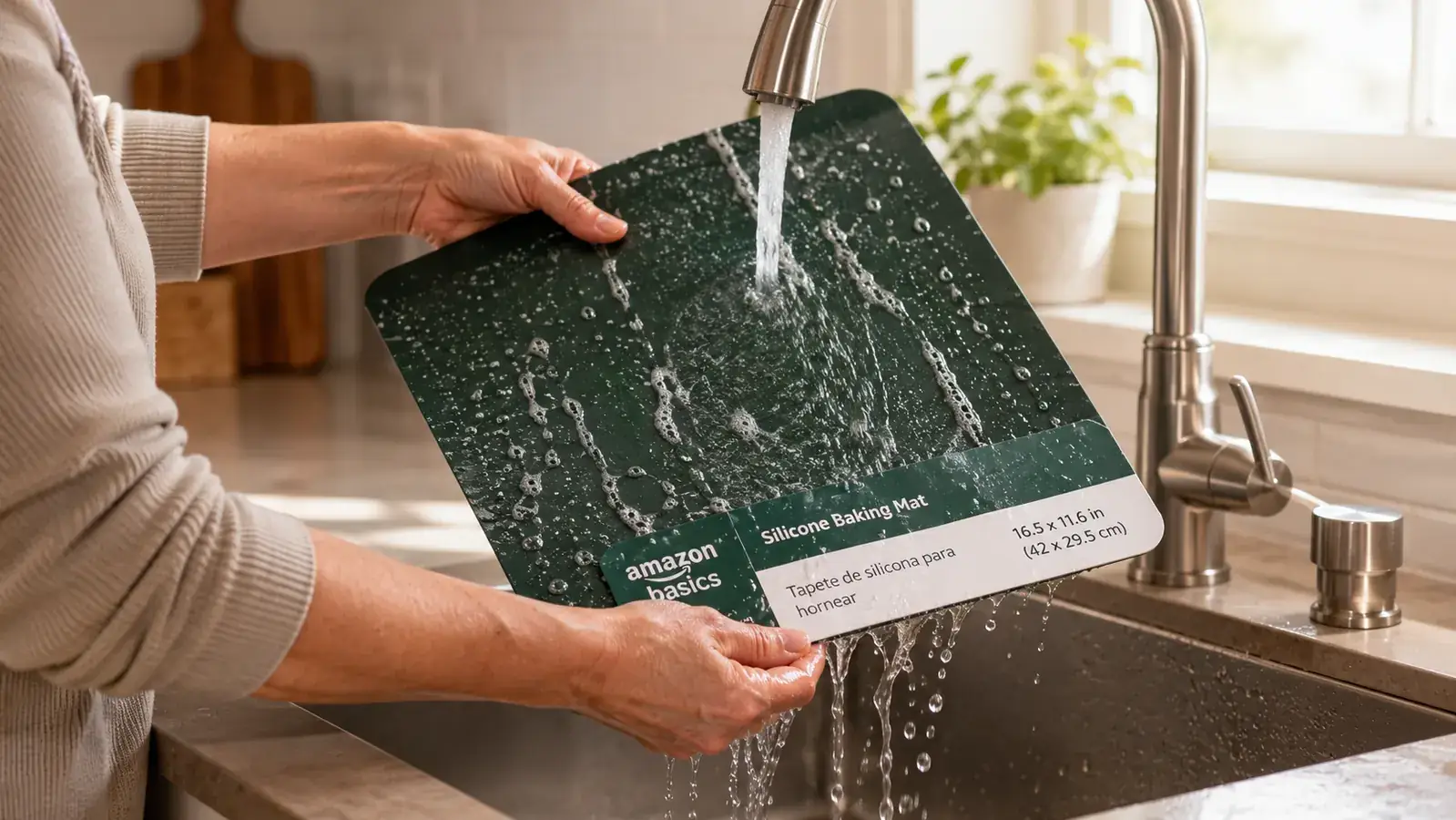
Cleanup is the reason this mat has permanently replaced parchment paper in my weekly routine. With parchment I was throwing away paper after almost every use, and while that is convenient in the moment, the waste adds up and the cost adds up. With the silicone mat, cleanup is about 20 seconds of effort. After a batch of cookies I rinse the mat under hot water, add a drop of dish soap if there is any oily residue, give it a quick wipe with my hand or a soft cloth, rinse again, and hang it on the dish rack. Done. Grease slides off like the mat actively repels it, which it basically does given the non-stick silicone surface.
I ran both mats through the dishwasher twice out of curiosity, top rack, normal cycle. They came out fine both times, no warping, no surface changes, no change in non-stick performance. The mats looked slightly less glossy afterward, more of a matte finish, but performed identically. I still prefer hand-washing because it takes less than a minute and means the mat is ready to go right away rather than waiting for the dishwasher cycle to finish.
Around month three I noticed that the mat used for savory roasting had picked up a faint background smell of garlic and onion from repeated sessions. It does not transfer flavor to sweet baked goods, I tested this specifically by making sugar cookies on that mat right after a garlic-heavy vegetable roast, and the cookies tasted exactly right. But the smell is there if you hold the mat up and sniff it. Since the mats come in a two-pack anyway, I solved this by designating one for savory cooking and one for sweet baking. Problem gone.
Durability: What 8 Months of Heavy Use Actually Looks Like
Neither mat shows any cracking, tearing, or delamination after eight months of near-daily use. The printed measurement circles and grid lines on the surface for centering baked goods have faded to about 70 percent of their original visibility, but those markings serve a convenience function rather than a cooking function, so the fading does not matter at all in practice. The structural integrity of both mats is exactly what it was when they arrived. They lie completely flat on the sheet pan, the edges are still firm and straight, and rolling them for storage has not introduced any permanent creases.
I paid close attention to the edges, because cheaper silicone mats often show the fiberglass mesh at the cut edge, which can fray over time or allow food to seep in. The Amazon Basics mat seals the edge cleanly. After eight months and dozens of washes, I see no fraying and no separation between the silicone layers at any point along the edge. That is genuinely good construction for the price.
The stress test that impressed me most was a batch of caramel-coated pecans in December. Caramel is one of the most aggressively sticky things you can bake, and once it cools on a surface it bonds with a ferocity that makes prying it off without breaking the nuts extremely annoying. On this mat, the cooled caramel released cleanly when I lifted each cluster. The mat needed a few minutes of soaking in warm water rather than the usual quick rinse, but nothing required any real scrubbing and nothing left a permanent stain on the mat surface.
What I Liked
- Substantially reduces hot spots and uneven browning on cookies and roasted vegetables
- Near-zero sticking on everything I have tried including caramel-coated nuts, thin cookies, and sticky glazes
- Cleanup is genuinely fast, usually 20 to 30 seconds of hand-washing
- Durable through 8 months of near-daily use with no cracking, curling, edge fraying, or delamination
- Two-pack lets you keep one for savory and one for sweet, solving the scent-retention issue entirely
- Fits a standard half-sheet pan precisely with no overhang, sliding, or gaps
Where It Falls Short
- Insulates slightly too much for very thick, cakey cookies that need a firm baked bottom
- Retains faint savory cooking smells after repeated high-heat roasting sessions
- Printed measurement markings fade with washing, though they have no effect on baking performance
- Not suitable for temperatures above 480 F, so it rules out certain broiler-adjacent applications
How It Compares to Alternatives I Considered
Before committing to these mats, I looked seriously at the Silpat brand, which is the name most serious home bakers mention first. Silpat mats run around $25 to $30 each versus roughly $6 per mat in the Amazon Basics two-pack at today's price. I have baked on a friend's Silpat and it is excellent, a marginal step up in surface consistency and probably a notch more durable over a very long horizon. But the functional difference in day-to-day home baking, even for someone who bakes four nights a week, is not something I can honestly describe as worth four or five times the price. For a home kitchen where I want consistent results without spending a lot, the Amazon Basics mat delivers everything I actually need.
I also tried a no-name silicone mat from a discount store before landing on this one. That mat smelled noticeably chemical for the first two months, started to curl at the edges after about six weeks of use, and developed slightly tacky spots on the surface where the non-stick coating seemed to be degrading around month three. The Amazon Basics mat has had none of those issues. There is a meaningful quality difference between the bargain versions and this one, even though the price of this one is already quite low. You are not saving much by going cheaper, and you lose a fair amount.
Who This Is For
This mat makes sense for anyone baking cookies or roasting vegetables at least once or twice a week who wants consistent results without the ongoing cost of parchment paper. The savings on parchment alone cover the two-pack price within two or three months of regular baking, and after that you are just getting free consistent performance. It is also a genuinely good choice for anyone who hates spending time on cleanup, because 20 seconds of rinsing versus scrubbing a greased pan or peeling stuck parchment off cookies is a real quality-of-life improvement at the end of a long day. If you have kids who request cookies on short notice, like I do, having this mat already on the pan means there is essentially no prep step between wanting cookies and having dough in the oven.
Who Should Skip It
If your baking is almost entirely thick, dense cookies that need a firm, set base, or if you regularly use your oven at broil temperatures above 450 F, the silicone mat works against you in those specific applications. It also is not my first choice for baking rustic breads directly on a sheet pan where maximum bottom crust browning is the goal. And honestly, if you bake only a few times a year, parchment paper is more practical, because you can toss it when you are done and not think about storage or washing. This mat earns its place for people who cook regularly. For occasional bakers, it is a nice-to-have rather than a must-have.
Still restocking parchment rolls every few weeks? One two-pack of these mats covers you for years.
The Amazon Basics silicone baking mat carries a 4.7-star rating from more than 25,000 buyers. At today's price, most regular home bakers recover the cost in parchment savings within six to eight weeks.
Amazon Check Today's Price on Amazon →