
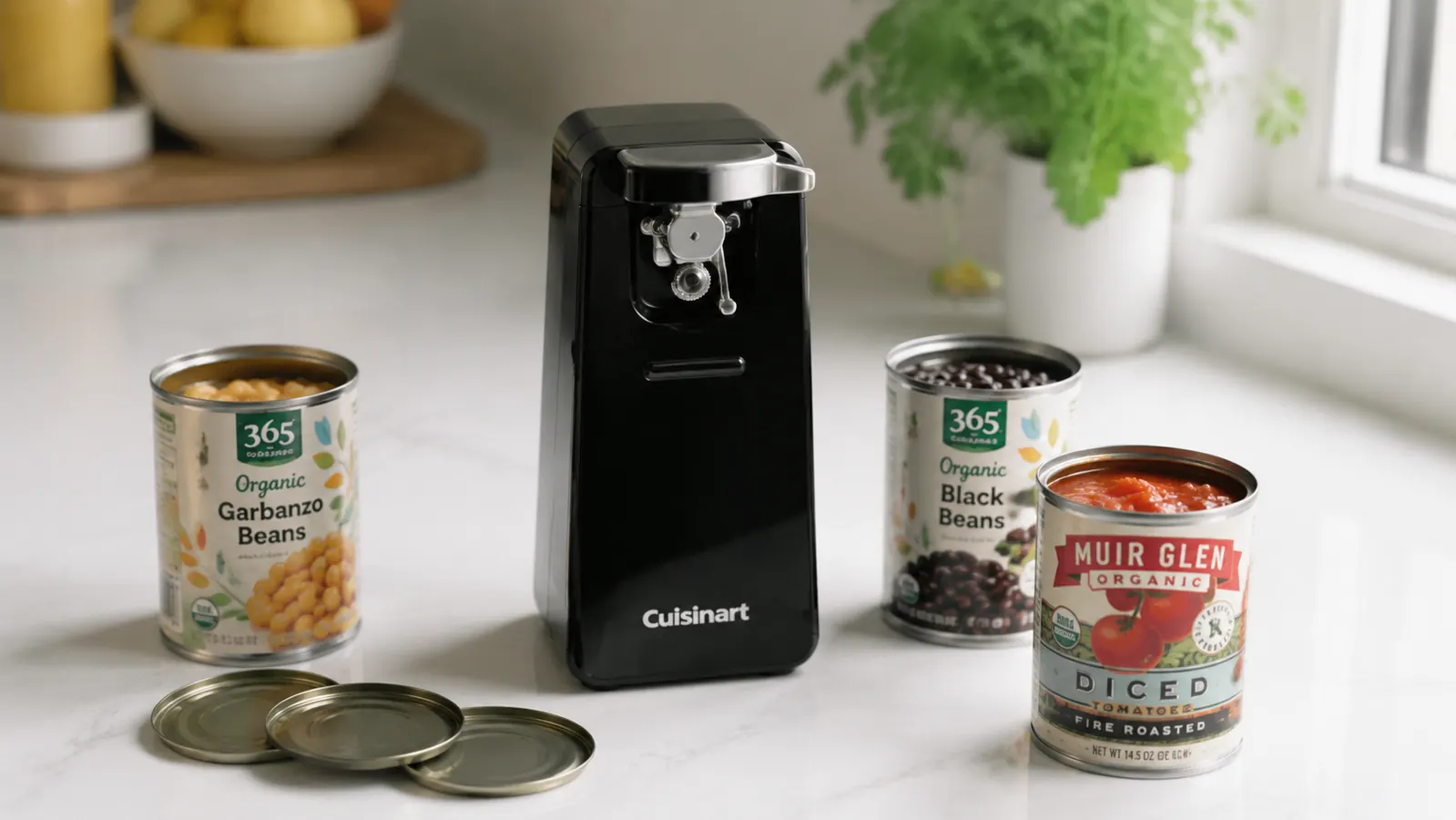
When a product has 63,270 Amazon ratings and a 4.5-star average, one of two things is true. Either it is genuinely great, or it is great at managing expectations so well that most buyers feel satisfied even when the product has real flaws. The Cuisinart electric can opener, model CCO-50BKN, sits in interesting territory: it is legitimately a good appliance, but the rating crowd contains a lot of people who were replacing something much worse, which makes the bar look lower than it is. Before you hand over your counter space and your money based on a number, let me tell you what the rating average is not capturing.
I have spent real time with this opener, comparing it against the Hamilton Beach 76606ZA (the most common alternative buyers look at), checking the things that generate one-star complaints, and thinking hard about the specific kitchen situations where it earns its keep versus the ones where it does not. This is not the feel-good version of this review.
The Quick Verdict
A reliable and genuinely useful electric can opener, but the things that cause returns are specific and avoidable if you know them going in.
Amazon Check Today's Price →If you have burned through two cheap openers in three years, stop buying cheap openers.
The Cuisinart electric can opener costs about the same as two replacement manual openers and outlasts both of them. Over 63,000 buyers agree. Check the current price and availability.
Amazon Check Today's Price on Amazon →The Thing Nobody Explains About How It Actually Cuts
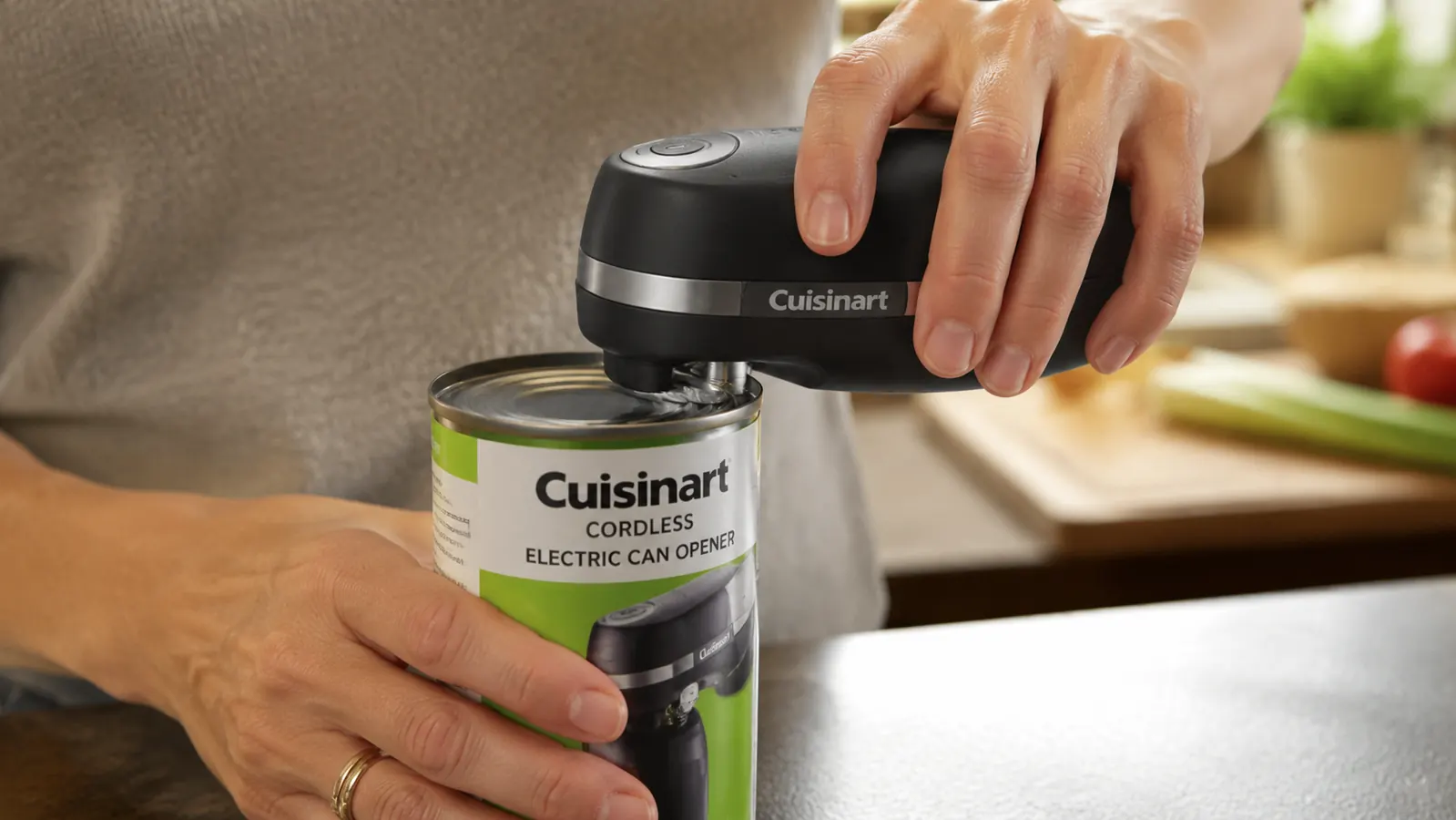
Most home cooks assume an electric can opener works the same way a manual opener does, just with a motor doing the cranking. That assumption leads to a lot of confusion when they first use the Cuisinart. This opener does not cut through the top of the lid. It cuts along the side of the rim, below the top edge. The result is that the lid comes off cleanly, with no sharp curled edge on either the lid or the remaining can wall. You can reach into the open can without worrying about a razor rim. The lid itself is flat and un-deformed.
This is called a smooth-edge or safety-edge cut, and it is a deliberate design feature. But because most people have never seen it described this way before buying, the first use catches them off guard. They press the button, the unit drives around the rim, the magnet lifts the lid, and they look at the cut and think something went wrong because the lid came off differently than expected. Nothing went wrong. That is what it is supposed to do. The confusion is real enough that it accounts for a meaningful chunk of the early one-star reviews from people who returned a perfectly functional opener.
The practical implications of the side-cut are real. Because the blade engages the outer wall of the can rather than the top, the cut line sits a few millimeters below the top rim. That means the lid that comes off carries a very thin metal collar, and when you set the lid down it may feel slightly unfamiliar. You will also notice the can itself has a tiny smooth edge rather than the typical raw-cut rim. Both of these are features, not defects, but knowing they are coming makes the first use less startling.
What the One-Star Reviews Are Actually About
With 63,000-plus reviews you get a statistically meaningful sample of what goes wrong. I read through a few hundred of the negative ones and they cluster into three buckets. The first is misunderstanding the cut style, which I already covered above. The second is the cutting wheel corroding. The third is the unit stalling on cans with slightly thicker or irregular rims. Let me address the second and third, because they are real concerns.
The corrosion complaints follow a pattern: the buyer washes the detachable cutting arm, puts it back while still damp, and over time the metal gear and wheel develop rust. The fix is completely preventable. After rinsing the cutting arm, set it on a dish towel or paper towel and let it sit for five to ten minutes before snapping it back onto the body. The plastic housing traps moisture if you reassemble while wet. This is not mentioned clearly in the instruction sheet that ships with the unit, which is an oversight on Cuisinart's part. But it is not a product defect.
The stalling complaints are more nuanced. The motor in the CCO-50BKN is adequate but not powerful. On standard North American cans of every common size, it works without hesitation. On cans with slightly non-standard rim dimensions, European-style tins, cans that have been dented, or very old cans with a heavier gauge lid, the motor sometimes needs a second pass. In my experience, pressing the button a second time completes the cut. The unit does not strip or skip, it simply pauses. If you routinely open specialty or import cans, this is worth knowing. If you open standard grocery-store canned goods exclusively, you will likely never encounter it.
Cuisinart vs Hamilton Beach: An Honest Head-to-Head
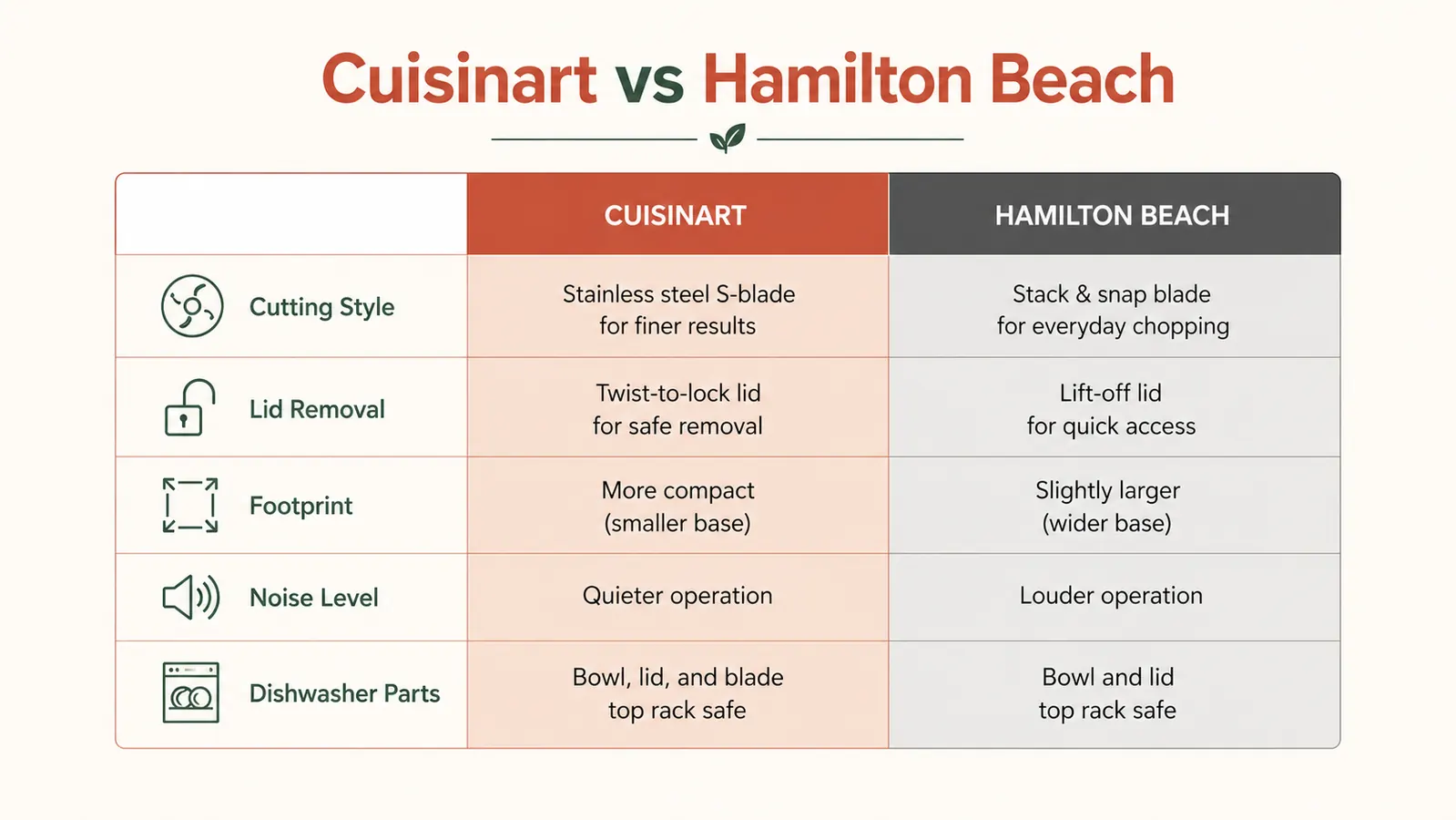
The Hamilton Beach 76606ZA is the closest direct alternative, priced within a few dollars of the Cuisinart and also carrying a massive review count. The two openers are more similar than their marketing suggests, but there are real differences worth knowing before you choose.
| Cuisinart CCO-50BKN | Hamilton Beach 76606ZA | |
|---|---|---|
| Cutting Style | Side-cut (smooth edge, no sharp lid) | Top-cut (traditional, sharp lid) |
| Lid Removal | Built-in magnet lifts lid automatically | Must manually retrieve lid from food surface |
| Footprint on Counter | Taller, narrower profile | Shorter, wider base |
| Noise Level | Moderate motor hum, 5-8 seconds per can | Slightly quieter on average |
| Detachable Parts for Cleaning | Yes, cutting arm lifts off | Yes, cutting arm lifts off |
| Works on Irregular Rims | Sometimes needs second pass | Also struggles with non-standard rims |
| Brand Heritage in Kitchen Appliances | Cuisinart, broadly trusted brand | Hamilton Beach, similarly trusted |
| Price Range | Around $25, check current price | Around $25-28, varies by retailer |
The single biggest practical difference is the lid removal. The Cuisinart's magnet lifts the lid away from the can automatically as the cut completes. With the Hamilton Beach, the lid falls into the food after the top-cut, and you fish it out with a fork or your fingers. For most people the magnet is the cleaner, more convenient behavior. For people who prefer knowing exactly where the lid went, the top-cut might actually feel more predictable. I lean toward the Cuisinart here because fishing a flat metal disc out of a can of chickpeas is an unnecessary step, but I recognize the preference is personal.
Sixty-three thousand reviews tells you the opener works. It does not tell you about the smooth-edge cut, the drying step, or the cord length. Those are the things that actually matter when it is sitting on your counter.
What the Price Actually Gets You Versus the Cheap Alternatives
There is a tier of electric can openers in the ten-dollar range sold under off-brand names with high review counts inflated by early-purchase incentives. I want to address this directly because budget-conscious buyers reasonably ask whether the Cuisinart at roughly twenty-five dollars is meaningfully better than a twelve-dollar alternative that looks nearly identical in the product photos.
In my experience, the main differences show up in motor durability and the quality of the cutting wheel bearing. Budget openers often work fine for the first six to twelve months and then the cutting wheel develops wobble, which causes incomplete cuts that require repositioning the can. The motor on cheaper units also tends to labor audibly on thicker cans in a way the Cuisinart does not. If you open cans infrequently (maybe once a week), a budget opener might suit you fine. If you open cans several times a week, the Cuisinart's motor is worth the extra cost simply because you will not be replacing the unit in a year.
The other thing you lose with the budget tier is the smooth-edge cut. Most of the sub-fifteen-dollar electric openers use a top-cut blade that leaves a sharp lid and a raw can rim. If you have ever nicked a finger on a freshly opened can, that detail matters. The Cuisinart's side-cut design removes that hazard entirely, and that design choice costs money to engineer correctly.
Counter Space Reality: How Much Room It Actually Needs
The Cuisinart CCO-50BKN measures roughly 6.5 inches tall by 4.5 inches wide by 4 inches deep. That is smaller than most people expect when they see it in product photos, but also larger than a forgotten gadget you can tuck into a corner. It needs a real dedicated spot, not a gap between the toaster and the paper towel holder.
Here is the honest truth about counter appliances: they only get used when they are already out. I have talked to people who bought this opener, put it in a cabinet to save counter space, and found themselves reaching for their manual opener out of habit every single time. The appliance sat unused until they either re-committed to leaving it on the counter or donated it. If you are not prepared to give it a dedicated spot on your counter, you may not get value from it no matter how good the opener itself is.
If counter space is genuinely limited, there is a version of this purchase that makes sense and a version that does not. It makes sense if you are already giving up counter space to something that earns its spot less reliably (a rarely-used toaster oven, a single-purpose appliance you use twice a year). It does not make sense if every inch of counter is already earning its keep with things you use daily.
The Specific Kitchen Situations Where It Earns Its Keep
The Cuisinart shines in a specific scenario: you cook dinner several nights a week from scratch, you rely on canned goods as an ingredient staple rather than an emergency backup, and at least occasionally you open three or more cans in a single cooking session. Soups, stews, curries, chilis, and pasta sauces all pull from multiple cans at once. Running four or five cans through an electric opener in sequence is dramatically faster and less tiring than doing the same with a manual opener. That time and effort savings compounds meaningfully across a week of real cooking.
It also earns its spot for anyone cooking for a household with a mix of ages and abilities. A teenager helping with dinner can operate this opener correctly on the first try. An older parent visiting for a week can use it without your help. The one-button operation eliminates the learning curve and the grip strength requirement at the same time, which makes it genuinely accessible in a way most kitchen tools are not.
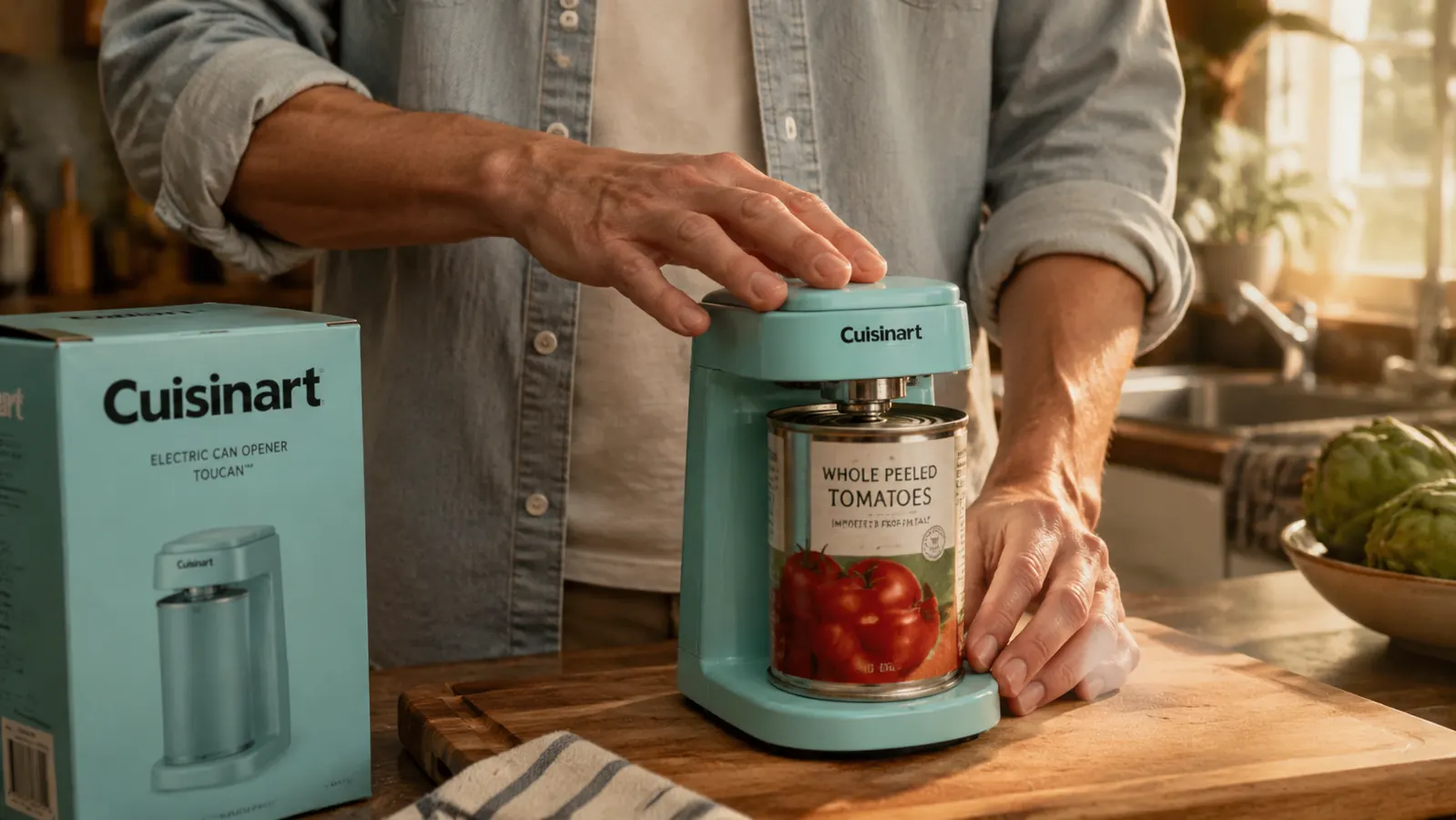
And for the practical detail worth stating plainly: the opener does not require you to be holding the can while it runs. You position the can, engage the mechanism, press the button, and you can turn away to stir something on the stove while it finishes the cut. The unit stays anchored on its rubber feet. This sounds minor but it changes how the task feels. Opening cans becomes a background step rather than a dedicated task requiring your full attention.

The Honest Gaps: What This Opener Does Not Do Well
The cord is 26 inches and that is genuinely constraining. It is not a solvable problem with creative counter arrangement; your nearest outlet needs to be within about two feet of where the opener will sit. Many kitchens handle this fine, but if yours has outlets positioned unusually far from the prep area, measure before buying.
The unit does not handle pop-top cans (the kind with a pull ring already built in), and it cannot open cans smaller than a certain diameter. Standard grocery canned goods from major brands are universally compatible. Specialty, import, or unusually sized cans are sometimes not. If your pantry regularly includes tinned fish from European brands, small cans of tomato paste in the 4-ounce size, or narrow-diameter cans of any kind, you will still need a manual backup for those specific items.
The body is plastic throughout, including the base. It holds up well in practice but picks up kitchen grime in the crevices between panels over time. Wiping it down monthly is the realistic maintenance requirement. If you are someone who finds it annoying when a countertop appliance requires any upkeep, this is worth noting even though the maintenance is genuinely minimal.
What I Liked
- Side-cut design removes sharp lid edges entirely, making open cans safe to reach into
- Built-in magnet lifts the cut lid away from food automatically, no fishing required
- One-button operation works correctly on the very first use, no learning curve
- Motor runs consistently on all standard North American grocery-store can sizes
- Stays firmly in place while operating, rubber feet hold position on tile and butcher block
- Detachable cutting arm makes cleaning straightforward when dried properly before reassembly
- 63,000-plus reviews represent a genuine long-term reliability track record, not a launch spike
Where It Falls Short
- Side-cut style surprises first-time users who expect a traditional top-cut; understand it before buying
- Cutting arm must be fully dried before reattaching to the body or corrosion develops over time
- Cord is only 26 inches, restricting placement options relative to available outlets
- Motor occasionally needs a second pass on non-standard, dented, or heavier-gauge cans
- Does not open pop-top cans, small-diameter cans, or irregular import-style tins
- Full plastic construction collects grime in panel seams and requires periodic wipe-down
Who This Is For
The Cuisinart electric can opener is the right buy for home cooks who use canned goods regularly (multiple times per week), value clean lid removal without sharp edges, and are prepared to give it a dedicated counter spot. It is also a strong match for anyone in the household who has reduced grip strength, limited hand mobility, or simply resents the physical effort of cranking a manual opener for multiple cans in a row. If you cook for a large household or do any batch cooking on weekends, the convenience compounds noticeably. You can read more about how the two opener styles compare in full detail over at the electric vs manual can opener comparison.
Who Should Skip It
Skip it if you open one or two cans a week and your hands are fine. A compact, well-made manual opener does that job without occupying counter space or requiring a power outlet. Skip it if every inch of your counter is genuinely occupied and you are not willing to displace something else to make room. And skip it if your pantry leans heavily toward specialty or import cans with non-standard rim sizes, because you will end up relying on your manual opener for those anyway and the use case for the electric narrows. For anyone curious about all the ways an electric opener changes day-to-day kitchen life, the piece on 10 reasons an electric can opener is worth it breaks down the specific scenarios where the switch makes the most practical sense.
A 4.5-star average across 63,000 people is not luck. Go in knowing the quirks and it will earn its counter spot.
The Cuisinart electric can opener is a genuinely reliable kitchen tool with one unusual cutting style you should know about before you open the box. Check today's price on Amazon and see if it fits your counter and your cooking routine.
Amazon Check Today's Price on Amazon →