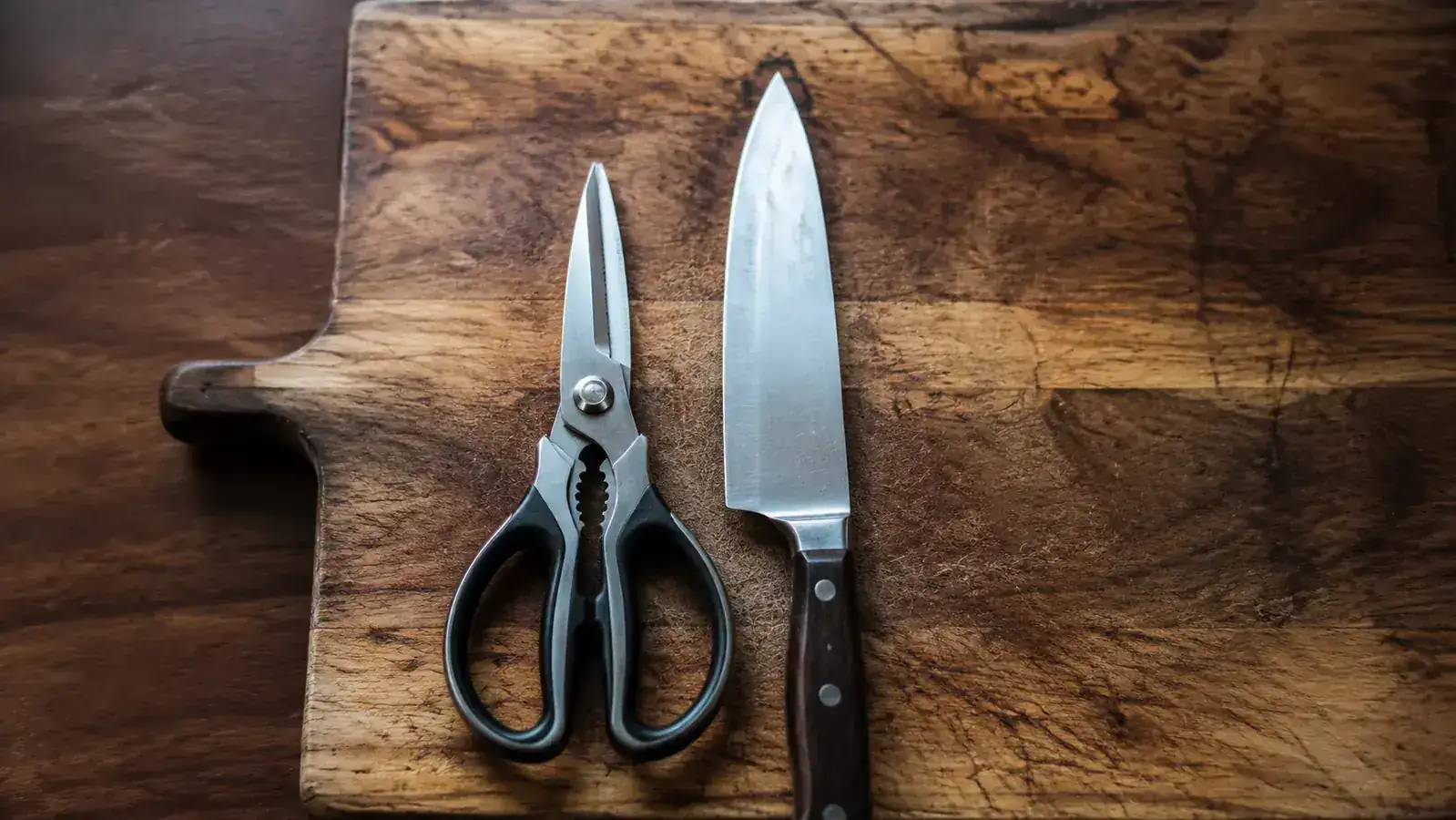
I used to treat kitchen shears like a backup. They sat in the drawer behind the knife block and came out maybe once a week to open a bag or snip a bit of twine. Then I started actually using them for prep, and I had to rethink everything. A good pair of shears is not a substitute for a chef's knife. But a chef's knife is not a substitute for a good pair of shears either. The question is not which tool is better in some general sense. The question is which one is faster, safer, and easier to clean for the specific job in front of you right now.
I have been cooking at home six nights a week for years, and I have tested both tools across every task I could think of: breaking down chicken, snipping herbs, cutting pizza, trimming green beans, portioning dried pasta, and opening packaging. What I found surprised me. The Gidli Kitchen Shears won more head-to-heads than I expected, and the knife defended its territory in fewer places than I assumed. Here is the full breakdown, category by category.
| Kitchen Shears | Knife for Food Prep | |
|---|---|---|
| Cutting raw chicken | Wins. Snip joints and trim fat without lifting the meat off the board. | Slower on joints; good for slicing breast meat flat. |
| Snipping fresh herbs | Wins. Direct into the pan, no board needed, zero waste. | Requires a board, rocking motion leaves behind fine bits. |
| Slicing onions and garlic | Awkward. Shears cannot rock or chop finely. | Wins. Nothing replaces a knife for allium prep. |
| Cutting pizza | Wins. Shears glide through toppings cleanly, no drag. | Slides cheese, drags toppings, requires a very sharp edge. |
| Trimming green beans or asparagus | Wins. Snip multiple stalks at once, fast and uniform. | One at a time or lined up; fine but slower. |
| Portioning dried pasta or noodles | Wins. One snip to desired length without breaking. | Breaks pasta unevenly; shears are clearly better here. |
| Breaking down butternut squash or dense veg | Too much leverage required; blade can slip. | Wins. A heavy knife with a rocking motion is the right call. |
| Opening vacuum packaging, bags, and ties | Wins. Handles the whole range without switching tools. | Possible but risky; blade can slip on plastic. |
| Cleanup | Pulls apart for dishwasher-safe cleaning; no edge to guard. | Hand wash strongly recommended; blade requires drying and care. |
Your chicken prep is taking twice as long as it needs to
The Gidli Kitchen Shears pull apart for dishwasher-safe cleaning and come with a lifetime replacement warranty. Over 12,000 buyers rated them 4.6 stars.
Amazon Check Today's Price on Amazon →Where Kitchen Shears Win Clearly
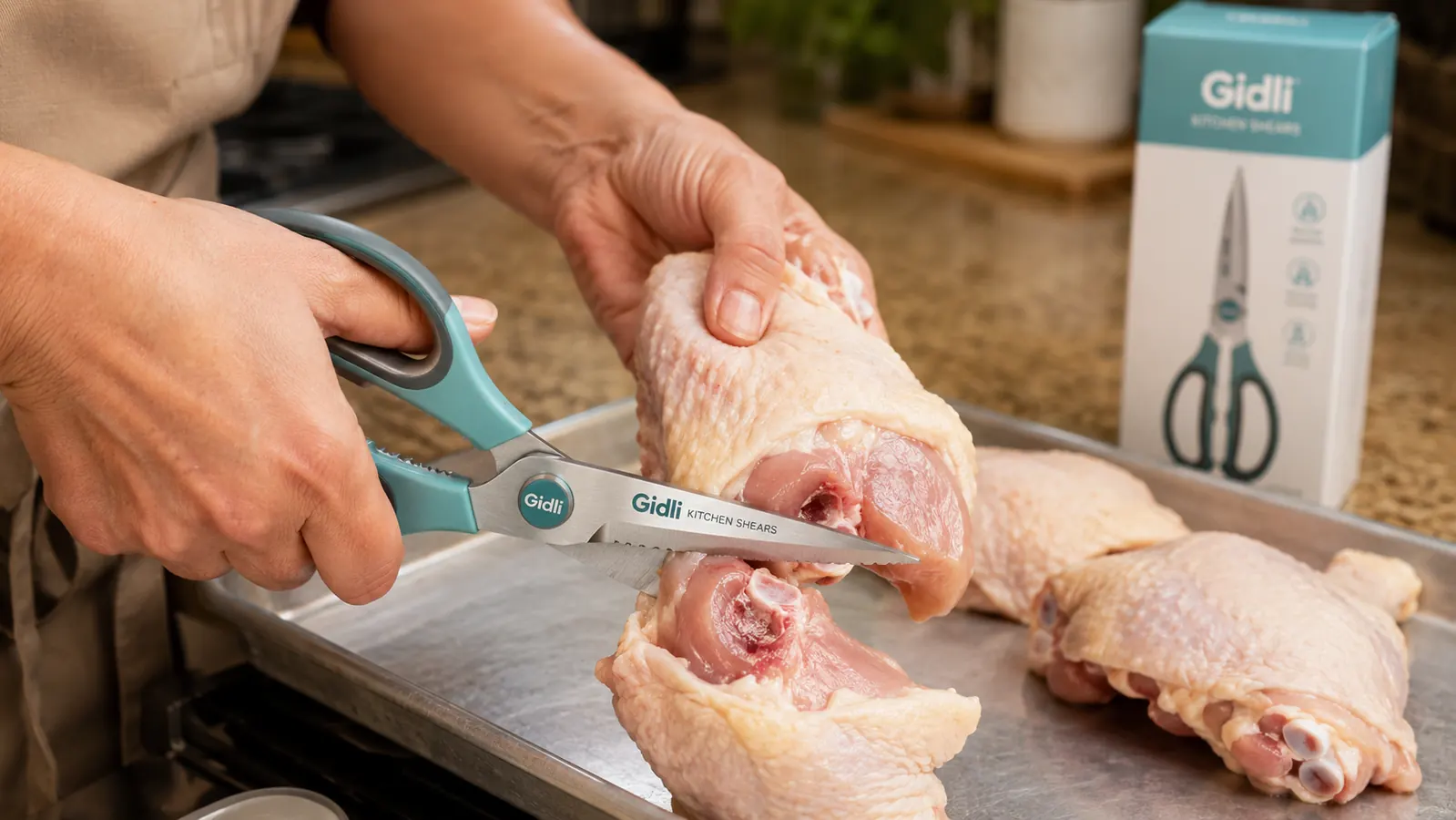
The most underappreciated use for kitchen shears is raw chicken. I used to drag a cutting board out, wrestle a whole chicken or a pack of thighs across it, and saw through joints with a knife that was never quite sharp enough for the task. Now I hold the piece directly over a sheet pan and snip. Joints, fat, skin, ribs. The shears go through all of it without any of the mess spreading to a board I then have to scrub. The Gidli shears have blades thick enough to handle bone-in cuts without flexing, and the micro-serration on one blade keeps the meat from slipping as you cut. That matters when you are doing this multiple times a week.
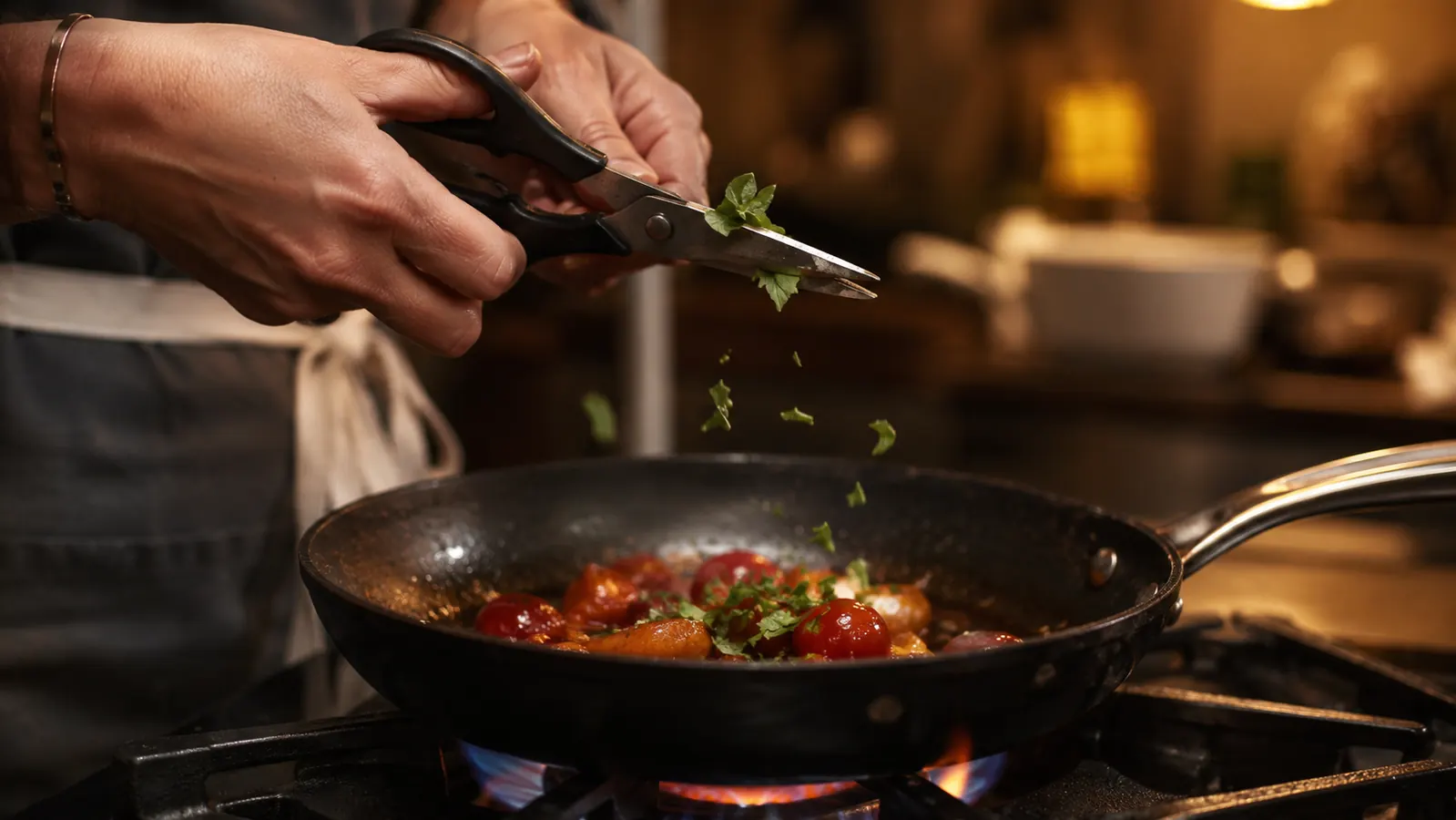
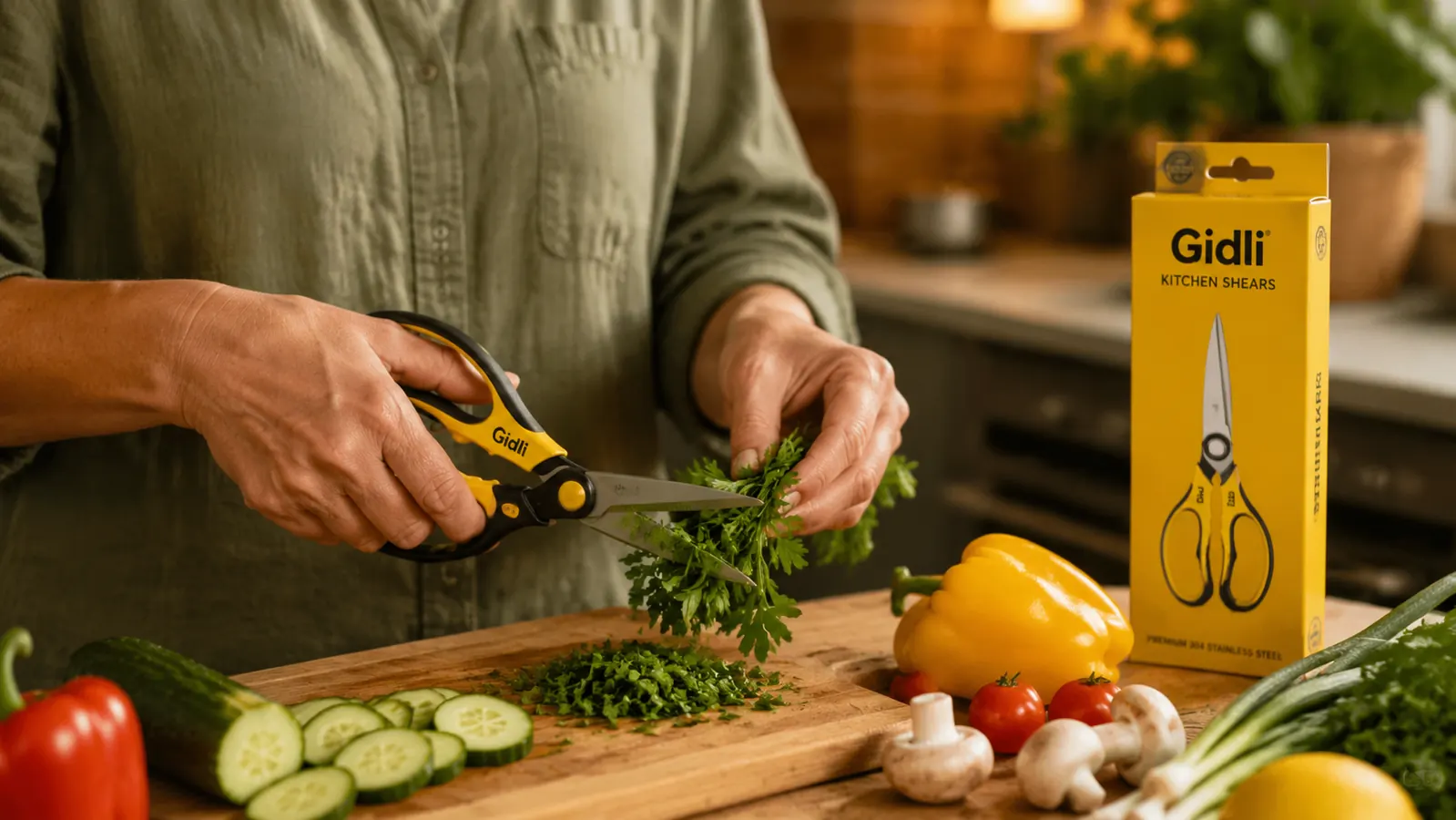
Herbs are the second category where shears beat the knife convincingly. With a knife, you need a dry cutting board, a pile of clean herbs, a rocking motion, and then you have to transfer the results into the pot. With shears, you hold the bunch over the pan and snip directly. You get more flavor because the cuts are cleaner and you do not lose essential oils to a damp board. Thyme, rosemary, flat-leaf parsley, chives, basil in thin ribbons. All of it is faster with shears, and there is one fewer board to wash at the end.
Pizza is another strong shear category. A pizza wheel gets cheese stuck in the spinner and requires a flat surface. A knife drags toppings all over the place unless the blade is razor sharp. Shears cut from the center outward and let you steer around a stubborn topping or a loaded edge without displacing anything. I also use them to snip fresh basil directly onto a finished pizza rather than tearing it by hand. If you make a lot of pizza at home, shears change the experience noticeably.
Green beans, asparagus, and scallions are faster with shears too. You can grab a handful of green beans, line up the ends roughly, and snip them all at once. With a knife you are lining them up on a board and chopping in batches. Scallions go directly from the bunch into the pan with a few quick snips. Dried pasta snaps and splinters when you try to cut it with a knife, but shears give you a clean cut at whatever length you need. These are small tasks, but they add up over a week of cooking.
Where the Chef's Knife Holds Its Ground
There are tasks where the knife is clearly the right choice and shears cannot compete. Onions are the most obvious example. The rocking chop you get with a good chef's knife is fast, and it produces the fine dice that shears simply cannot replicate. You need the flat cutting surface and the tip-pivot motion to get from rough chop to fine mince. Shears can technically cut an onion, but the result is uneven and slipping is a real concern. The knife owns this category without any real competition.
Garlic is in the same camp. You might use a press for most of your garlic prep, but when a recipe calls for a thin slice or a rough chop to finish a pan sauce or a vinaigrette, you need a knife. Dense vegetables are the other strong suit. Butternut squash, sweet potatoes, beets, and celery root all want the mass and straight-down leverage of a chef's knife. The blade's flat contact with the cutting board gives you feedback and control that a scissor motion cannot provide for hard produce. Trying to cut a butternut squash with shears is frustrating at best and a slip hazard at worst.
There is also a technique element. A chef's knife trains you in ways that actually make you a better cook. Learning to hold a consistent julienne, to rock through a pile of shallots, to slice proteins thinly for stir-fries. None of that translates to shears, and shears will never replace the knife for those tasks. The two tools are strongest when they coexist in the same kitchen, each handling what it is actually designed for.
I stopped thinking of them as competing tools. The shears handle anything soft, jointed, or packaged. The knife handles anything that needs a flat cut or a fine dice against a board.
The Real Speed Difference in Daily Cooking
Speed is the argument most often made for whichever tool someone already prefers, so it is worth being specific about what actually saves time. The shears save time at the source. You skip pulling out the cutting board, skip transferring ingredients to and from it, and skip washing it afterward. For tasks like herbs and scallions and pizza, that board removal is where most of the time savings live. The snipping itself is not dramatically faster than a good knife chop. The surrounding steps are where the difference adds up.
The knife saves time through volume and precision. If you are chopping a full onion, three cloves of garlic, and a carrot all for the same dish, a knife on a single board is faster than using shears and moving between containers. The knife's ability to process multiple items with a rocking chop, staying in one position on one surface, is a real efficiency advantage for high-volume allium and aromatic prep. Neither tool dominates across all tasks. The fastest cook is the one who reaches for the right one without stopping to think about it.
The Cleanup Difference Nobody Talks About
Here is something that rarely comes up in comparisons but matters a lot in daily cooking: what happens after the prep is done. A chef's knife should be hand-washed and dried immediately after use. If you run it through the dishwasher, the edge degrades faster, the handle can crack or loosen over time depending on the material, and full immersion is hard on most handle adhesives. That means one more thing to wash by hand at the end of a long cooking session. With raw chicken involved, that hand-wash is also a sanitation concern you have to be deliberate about.
Kitchen shears, specifically the Gidli pair, pull apart into two separate blades. Both halves go straight into the dishwasher. No edge to guard, no handle to worry about, no drying required. For anyone who cooks chicken several times a week, this alone is worth something. You are not skipping the cleaning step or doing a half-hearted rinse. You are doing a thorough clean every time with zero additional effort. Over a month of daily cooking, that difference in friction adds up in a way that actually changes how often you reach for the tool.
A Note on Shear Quality: Why the Brand Matters
Not all kitchen shears perform equally, and this comparison assumes you are using a pair worth owning. The cheap single-piece shears you sometimes find bundled in a kitchen set do not pull apart for cleaning, do not have the blade thickness to handle poultry joints without flexing, and tend to dull within a few months of real use. I tested three different pairs before settling on the Gidli Kitchen Shears. The difference between those and a cheap pair is more noticeable than the difference between a mid-range and a high-end chef's knife.
The Gidli shears are heavier than the cheap versions, which is actually a good thing for poultry work. The blades seat firmly when closed, there is no wobble in the pivot, and the grip is comfortable enough to use repeatedly without hand fatigue. The lifetime replacement warranty is a real differentiator at this price point. I have used mine for over a year on chicken bones, pizza, herbs, packaging, and dried pasta. They are still cutting cleanly without any sharpening.
Who Should Buy Which
You probably already own a knife. The real question is whether you also own a pair of kitchen shears worth using. If you cook chicken more than twice a week, use fresh herbs, make pizza at home, or find yourself snipping packaging with whatever is closest on the counter, a quality pair of shears will pay for itself in saved time within the first two weeks. They do not replace a knife. They take over a specific set of tasks where the knife is slower, messier, or harder to clean afterward.
If you are choosing between upgrading your knife or adding your first real pair of kitchen shears, I would lean toward the shears. Most home cooks are already working with a functional knife. Far fewer have shears that are actually good enough to trust with protein. Closing that gap changes your daily prep routine in ways a knife upgrade rarely does. For the full story on how I have used these over time, see my long-term kitchen shears review. And if you want practical technique for getting the most out of them, my guide on cutting chicken, herbs, and pizza with kitchen shears walks through it step by step.
Good shears are the prep upgrade most home cooks skip
The Gidli Kitchen Shears pull apart for dishwasher-safe cleaning, handle poultry joints without flexing, and come with a lifetime replacement warranty. Check today's price and see if they fit your kitchen.
Amazon Check Today's Price on Amazon →